
Expanded Article: Youth Activism in Madagascar
Way back in Season 2, Episode 1, we looked at youth-led protest movements. Here, lead writer Alex refreshes our memories and delves deeper into the Madagascar case study, exploring some key trends.

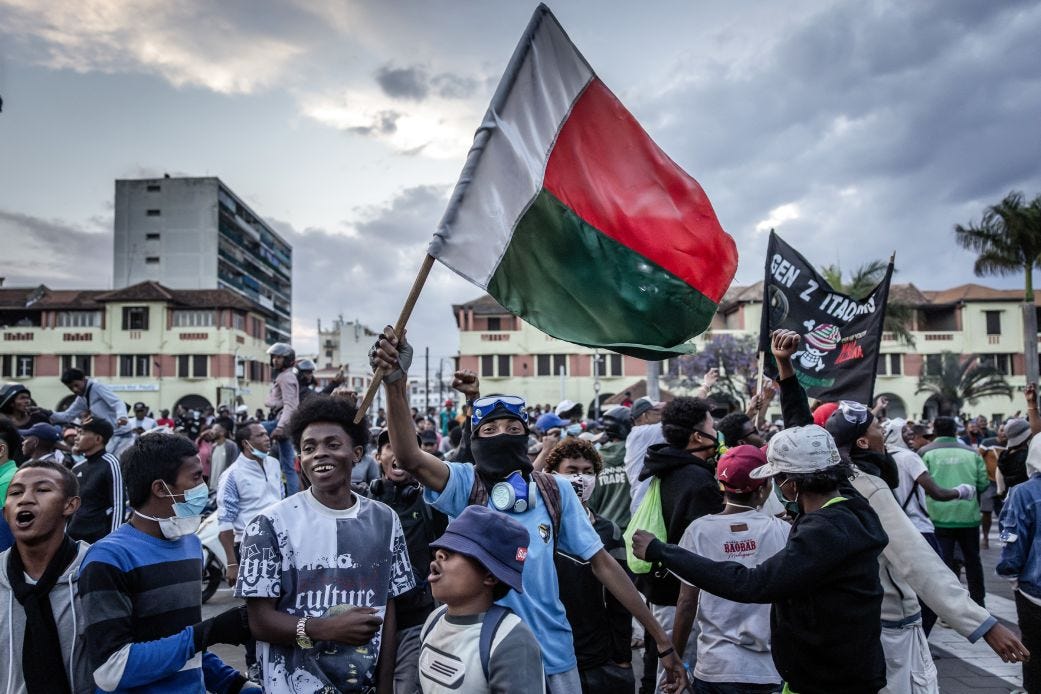
Since its 1960 independence from France, Madagascar has experienced multiple crises of government overthrow and/or mass protests due to poor living conditions and endemic corruption. Madagascar is very poor, with the fifth-lowest GDP per capita in the world–which is actually substantially lower than it was when Madagascar gained independence. This is despite President Andry Rajoelina’s promises to increase wages and reduce poverty. Madagascar offers very few prospects to its population, which has a median age of 20. Almost 70% of Malagasy citizens live on less than $3 per day, while the small elite is immensely wealthy. Regardless of all this, Rajoelina was controversially re-elected in 2023 amidst an opposition boycott. However, a number of youth-led protest movements have overthrown previously stable regimes in the last couple of years as Gen Z utilises technology and social media for coordination to unify around one message: enough is enough. That’s exactly what unfolded in Madagascar last month.
The protest’s start was in September 2025, when two city councillors of Antananarivo (Madagascar’s capital) were arrested for trying to organise a protest against water and electricity outages. This led to the creation of a leaderless group, Gen Z Madagascar, on Facebook, Instagram, Discord, and Signal, taking direct inspiration from other anti-corruption
Gen Z movements such as those in Bangladesh, Nepal, Indonesia, Kenya, Morocco, and Serbia. Demonstrations erupted across Madagascar in late September over widespread power and water outages, government failures that fuelled outrage pushing political mistrust to its limit. These protests then escalated from water and power cuts towards a complete overhaul of the political system as thousands of young protesters took to the streets of Antananarivo, holding up their phone flashlights and protesting Madagascar’s corrupt institutions and extreme poverty.
Rather than resigning and paving the way for a smooth democratic transition, Rajoelina clung to power by dissolving his government and holding dialogues with different groups, but this was not enough to satisfy the protestors. Over the weekend of 11-12 October, Rajoelina warned an illegal attempt to seize power was underway as his elite CAPSAT military unit, which helped bring him to power in a 2009 coup, joined the protestors in the centre of Antananarivo. Rajoelina fled the country the next day, after weeks of the Gen Z Madagascar-led protests. In doing so, he abandoned the presidency in the same way as his predecessor, reportedly aboard a French plane to Dubai. The resulting power vacuum allowed Colonel Michael Randrianirina to declare on 14 October that the military had taken power, dissolving all institutions except the lower house of parliament, which had voted to impeach Rajoelina for desertion of duty due to his flight from the country. The African Union (AU) suspended Madagascar with immediate effect following the military coup, stating the rule of law must triumph over the rule of force.
Because Gen Z Madagascar is decentralised and does not have a strong leader or comprehensive ideology, it could dissipate rapidly now that Rajoelina has departed, even though Randrianirina may represent a mere pivot to a different elitist autocrat. It remains to be seen how much patience Gen Z Madagascar and the Malagasy youth in general will allow Randriarina, but many Malagasy currently seem inclined to give their country’s new leader the benefit of the doubt, cheering on Rajoelina’s departure with cautious optimism towards the future. For his part, Randrianirina has already announced an investigation into Jirama, the state-owned water and power company; appointed Herintsalama Rajaonarivelo, a businessman and consultant, as Madagascar’s new Prime Minister; and promised to hold elections in the next 2 years. Again, it remains to be seen whether or not this promise will be upheld, as several other former French colonies in sub-Saharan Africa have recently undergone military coups in which generals initially promised to hold elections only to extend their own terms, such as Mali’s Assimi Goïta and Burkina Faso’s Ibrahim Traoré.
Madagascar’s youth-led protest movement was inspired by the crises it saw in social media. This is the first of two trends the recent events of Madagascar exemplifies: the international rise of self-styled Gen Z protests, as has been mobilised in the last couple of years by young people in Nepal, Morocco, Kenya, Peru, Bangladesh, Indonesia, and more. These protests are all oriented in technology and led by members of Gen Z, those born between the mid-1990s and early 2010s. Malagasy activists joined the Nepali Gen Z discord group to garner protest tips, while Gen Z Madagascar adopted the skull and crossbones flag from Japanese anime series One Piece, which has been flown in youth-led protests in Indonesia and the Philippines in August and September.
The second theme here is that of recent African military coups. The 2020s are only halfway over but have already seen ten African coups including Madagascar, which marks more than the entirety of the 2000s or the 2010s. Madagascar joins Niger (2023), Gabon (2023), Burkina Faso (2022), Mali (2021), and Guinea (2021) as the sixth former French colony in sub-Saharan Africa to experience a military coup in the last five years. However, this portrayal of recent events in Madagascar as a coup is contested. Rajoelina argues from exile that it was a sudden and unlawful seizure of power by a military officer, and that because he had won the most recent presidential elections in 2023, he is still the rightful President from abroad. The AU backs Rajoelina on this, but Randrianirina argues that in sacking his government, dissolving Parliament, and then fleeing the country, Rajoelina effectively vacated his office. Madagascar’s Constitutional Court concurs, as do most protestors. This debate matters because the AU has a zero-tolerance policy on coups, and many Western countries, including the US, have laws requiring them to immediately suspend aid after a coup. Like the states above, this may reflect a pivot in Madagascar’s foreign policy, away from France and towards Russia. Randrianirina attended a meeting with Russian embassy officials shortly after assuming the interim presidency–but as with everything else, we will simply have to wait and see.
Sources